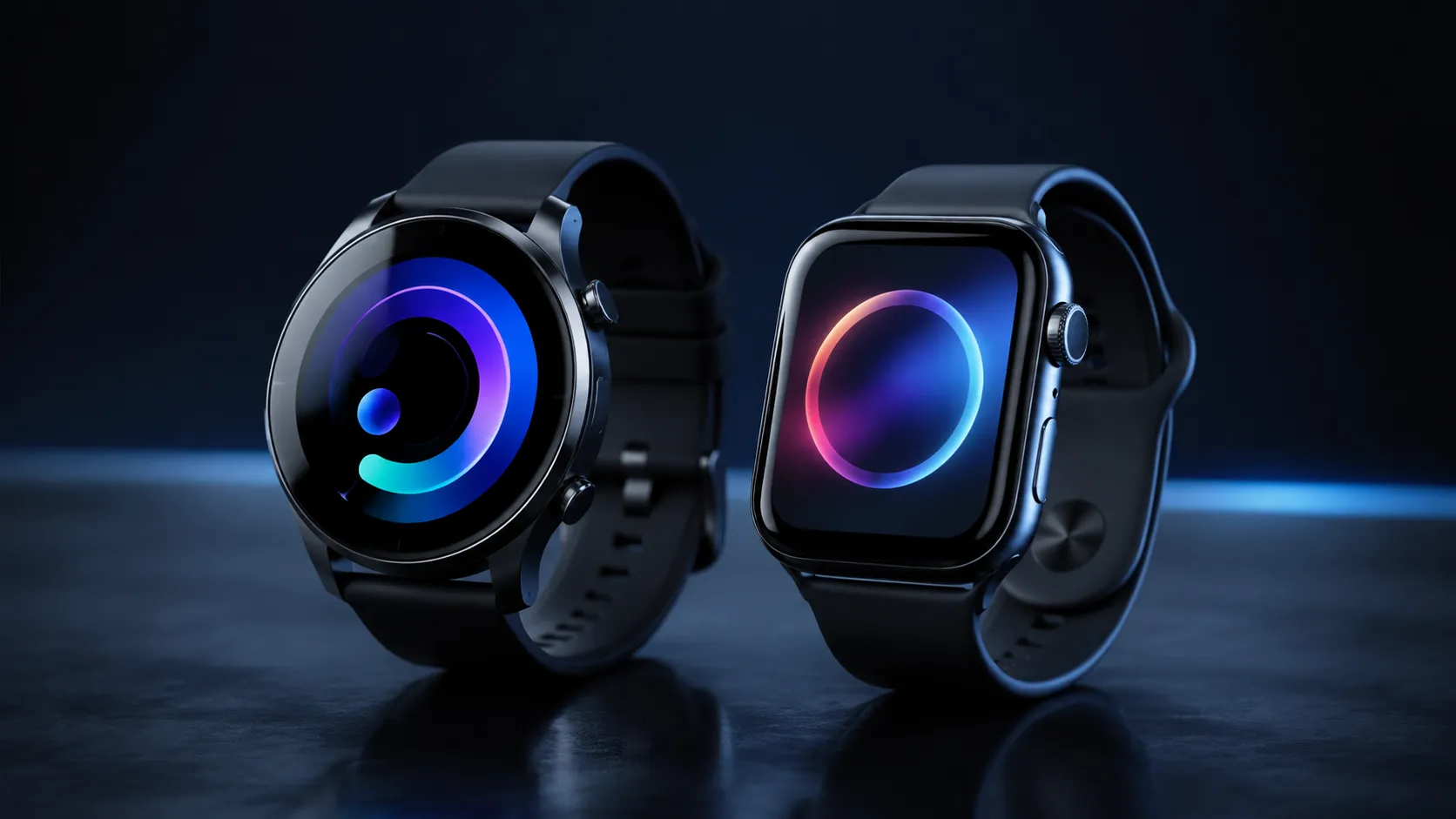
Galaxy Watch 7 vs Apple Watch 10: the right choice depends first on your phone. Choose the Apple Watch Series 10 if you use an iPhone. Choose the Samsung Galaxy Watch7 if you use Android, especially a Samsung Galaxy phone. Apple wins for its polished apps, fast charging, larger usable display, and seamless iPhone integration. Samsung costs less, uses sapphire crystal on every model, offers broader body-composition tools, and gives Android buyers the better fit.
If you are considering switching phone platforms, the comparison gets closer. This guide breaks down the differences that actually affect daily wear instead of declaring a winner based only on specifications.
Galaxy Watch 7 vs Apple Watch 10: Quick Verdict
- Best for iPhone: Apple Watch Series 10
- Best for Android: Samsung Galaxy Watch7
- Best display and charging: Apple Watch Series 10
- Best value and scratch resistance: Galaxy Watch7
- Best health overview: Galaxy Watch7, especially with a Samsung phone
- Best app experience: Apple Watch Series 10
Bottom line: neither watch is a sensible cross-platform purchase. Apple Watch Series 10 requires an iPhone, while Galaxy Watch7 works with Android and saves some advanced features for Samsung Galaxy phones. If your phone is not changing, your decision is already mostly made.
Galaxy Watch 7 vs Apple Watch 10 at a Glance
| Feature | Galaxy Watch7 | Apple Watch Series 10 |
|---|---|---|
| Phone compatibility | Android; best with Samsung Galaxy | iPhone only |
| Case sizes | 40mm or 44mm | 42mm or 46mm |
| Shape | Round | Rounded rectangle |
| Display | Super AMOLED, sapphire crystal | Wide-angle LTPO3 OLED; Ion-X on aluminum, sapphire on titanium |
| Peak brightness | Up to 2,000 nits | Up to 2,000 nits |
| Storage | 32GB | 64GB |
| Rated battery | Up to 40 hours with always-on display off | Up to 18 hours normal use; 36 hours in Low Power Mode |
| Water resistance | 5ATM and IP68 | 50m water resistance and IP6X dust resistance |
| Starting MSRP at launch | $299.99 | $399 |
| Best for | Android value and Samsung health tools | iPhone integration and polished apps |
Specifications come from Samsung’s Galaxy Watch7 page and Apple’s Series 10 technical specifications. Retail prices can differ now that both are older-generation models, so compare the current price rather than relying on launch MSRP.


Compatibility Decides Galaxy Watch 7 vs Apple Watch 10
The Apple Watch Series 10 pairs only with an iPhone. The Galaxy Watch7 requires an Android phone, and features such as ECG and blood-pressure measurement can depend on region, phone brand, and Samsung Health Monitor availability. That means the “better” watch can still be the wrong purchase if it does not support your phone.
Samsung lists Galaxy Watch7 as compatible with phones running Android 11 or later; non-Samsung Android phones are supported, although some Samsung-specific features can be limited. Apple lists Series 10 as compatible with iPhone XS or later, iOS 18 or later, and watchOS 11 or later. To install the current watchOS 26 software, Apple requires an iPhone 11 or later running iOS 26.
If you use a Samsung Galaxy phone, Watch7 offers the cleanest Android experience. If you use another Android brand, the watch still handles notifications, apps, workouts, sleep, GPS, and everyday health tracking, but confirm access to any specific Samsung-only feature you care about before buying. Our best smartwatch for Android guide covers more alternatives.
Both watches can record distance, pace, and routes with built-in GPS when your phone is not with you. On non-cellular models, calls, messages, streaming, and live notifications generally require the paired phone or a usable Wi-Fi connection. LTE or GPS + Cellular versions can handle more connected tasks without the phone nearby after activation on a supported carrier.
Carrier eligibility varies, and a separate wearable plan with an additional monthly charge may apply. Check Apple’s carrier list or Samsung’s LTE activation guidance before paying extra for cellular hardware. Our guide to whether a smartwatch needs a data plan explains when the extra service is worthwhile.
Design and Comfort
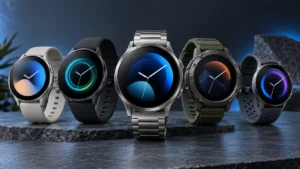
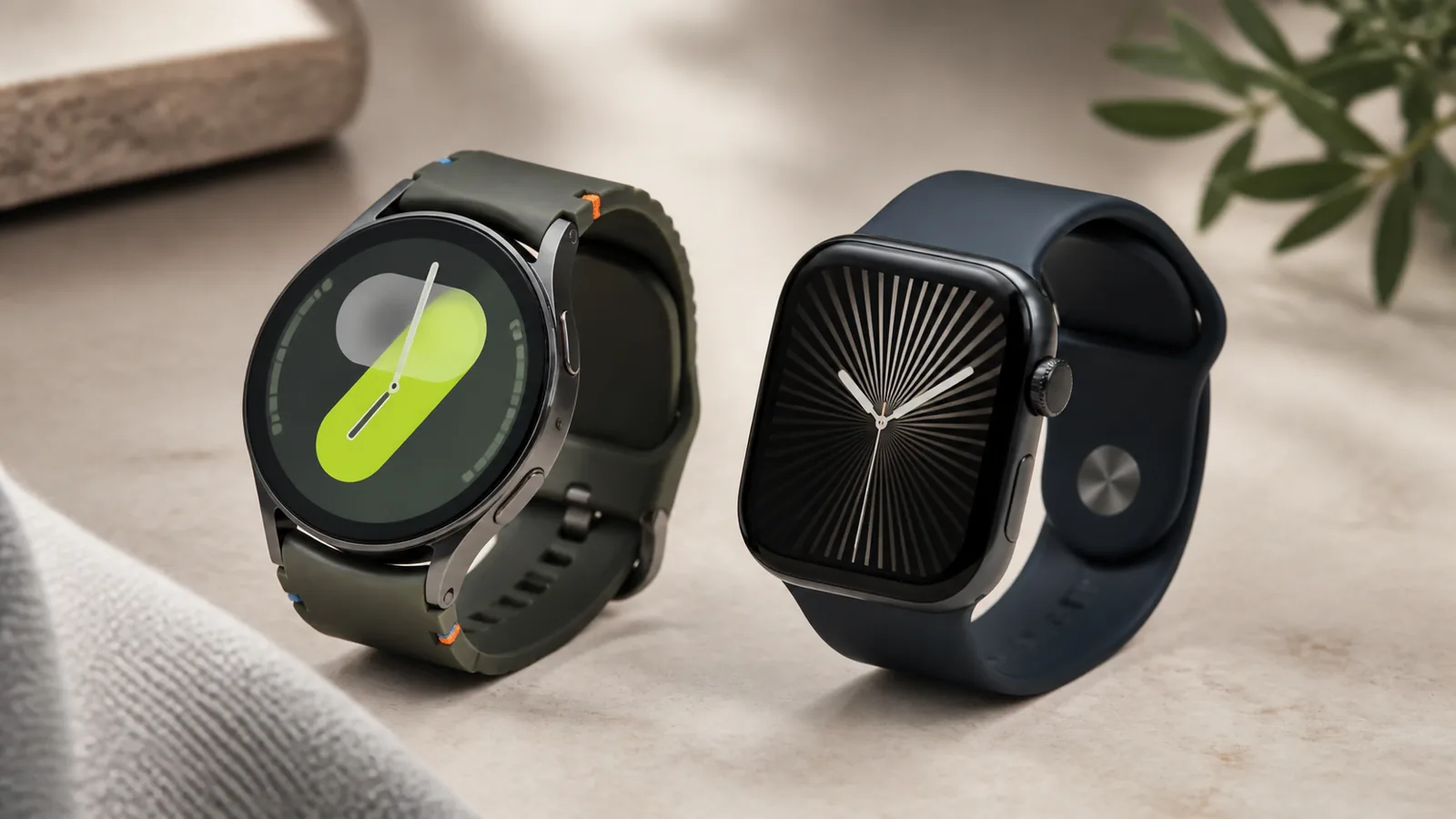
The design choice is simple: Galaxy Watch7 looks more like a traditional round watch, while Series 10 uses Apple’s familiar rounded rectangle. Samsung offers 40mm and 44mm cases. Apple offers 42mm and 46mm cases, with a thinner 9.7mm profile that sits comfortably under a sleeve.
Samsung gives every Watch7 a sapphire-crystal display, a meaningful advantage for shoppers concerned about scratches. Apple’s aluminum Series 10 uses Ion-X glass; sapphire crystal is reserved for the more expensive titanium models. Apple counters with more usable screen area, particularly on the 46mm model, and its wide-angle OLED is easier to glance at from an angle.
Which Size Should You Buy?
Choose the smaller 40mm Galaxy Watch7 or 42mm Apple Watch if you have a smaller wrist, sleep with your watch, or prefer less bulk. The 44mm Galaxy Watch7 and 46mm Series 10 are easier to read and tap, but their larger footprint can feel awkward during sleep or strength training. If style and smaller sizing matter most, see our guide to smartwatches for ladies.
Display and Everyday Controls
Both displays are bright, colorful, always-on capable, and rated up to 2,000 nits. Apple makes better use of rectangular space for messages, lists, maps, and app interfaces. Samsung’s circular screen feels more watch-like and works well with its touch bezel, but corners of rectangular content naturally disappear.
Apple’s Digital Crown remains the more precise physical control for scrolling. Galaxy Watch7 relies on touch, two side buttons, and a digital bezel around the display edge. Neither approach is difficult; the choice comes down to the Crown’s tactile feedback versus Samsung’s cleaner round design.
Health and Sleep Tracking
Both watches track heart rate, sleep, skin temperature, activity, and workouts, and both support ECG where the feature is approved and configured. They also offer sleep-apnea-related features in supported regions. These are wellness tools, not replacements for medical diagnosis or professional care.
Galaxy Watch7 provides a broader dashboard through Samsung Health. Its BioActive Sensor supports body-composition estimates, and Samsung combines sleep, activity, heart rate, and other signals into an Energy Score. Body-composition readings can be useful for observing trends, but hydration and measurement conditions can affect results.
Apple’s Health, Vitals, Activity, and Workout apps feel exceptionally cohesive on iPhone. Series 10 also includes a depth gauge and water-temperature sensor for shallow-water activities. In the United States, blood-oxygen availability on Apple Watch hardware has varied by sales date and model configuration, so verify the feature on the exact unit rather than assuming it is enabled.
Both watches provide fall detection and emergency assistance, but the details differ. Apple Watch Series 10 includes Emergency SOS, Fall Detection, Crash Detection, and international emergency calling in supported regions; Emergency SOS requires a cellular connection or Wi-Fi calling through the watch or a nearby iPhone. Galaxy Watch7 supports Emergency SOS, hard-fall detection, emergency contacts, and SOS calls or messages, with stand-alone use depending on an activated LTE connection. Configure these features before relying on them because availability and connectivity vary.
Fitness and GPS
Galaxy Watch7 and Apple Watch Series 10 both cover everyday running, walking, cycling, swimming, gym workouts, heart-rate zones, and route tracking. Samsung added dual-frequency GPS to improve positioning around tall buildings and tree cover. Apple’s Workout app offers strong customization, Training Load, and an established third-party fitness app ecosystem.
For casual fitness, both are more than capable. Choose Samsung if body composition, Energy Score, and Android integration appeal to you. Choose Apple if you want polished workout apps, tighter iPhone syncing, and a larger ecosystem of watchOS accessories and services. Buyers focused mostly on training and multi-day battery life should also compare Garmin vs Fitbit.
Battery Life and Charging
Galaxy Watch7 has the longer official ceiling: Samsung rates it for up to 40 hours with the always-on display off and up to 30 hours with it on. Real-world endurance varies with size, GPS, LTE, sleep tracking, brightness, and background health measurements. It is best treated as roughly a one-day watch with some breathing room, not a multi-day adventure watch.
Apple rates Series 10 for 18 hours of normal use or 36 hours in Low Power Mode. Its major advantage is charging speed: Apple says it can reach about 80% in 30 minutes with compatible fast-charging hardware. That quick top-up can matter more than a few extra rated hours if you want to wear the watch overnight for sleep tracking.
Apps, Notifications, and Smart Features
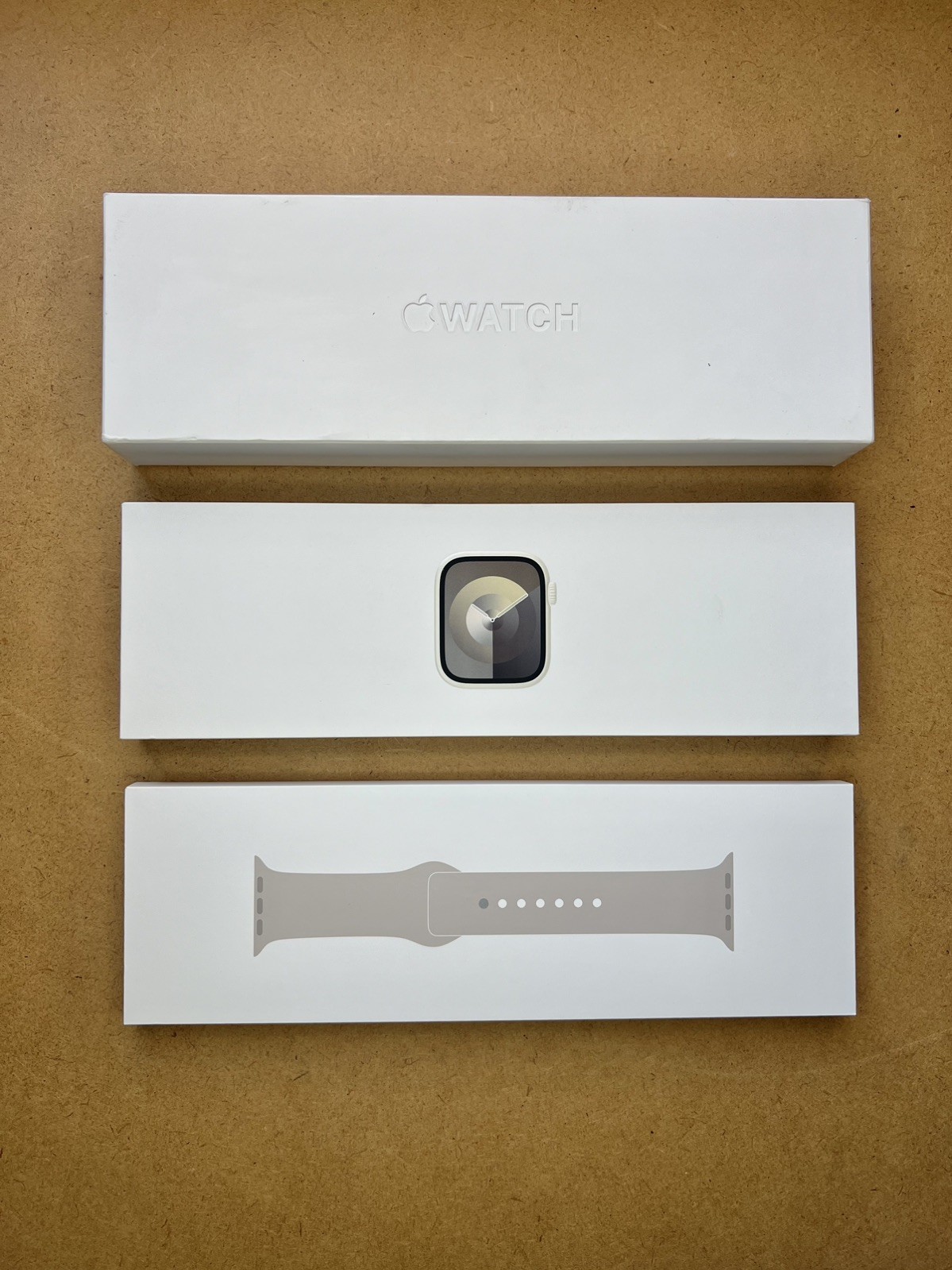
Apple Watch Series 10 has the more mature app experience. Messages, calls, timers, music, navigation, Wallet, Siri, and third-party apps behave like natural extensions of an iPhone. Its 64GB of storage is also double the Galaxy Watch7’s 32GB.
Galaxy Watch7 runs Wear OS with Samsung’s One UI Watch interface. It handles Google Maps, Google Wallet, YouTube Music, notifications, calls, and Play Store apps well, while Samsung apps deepen the experience for Galaxy phone owners. If you already use Google and Samsung services, it feels familiar rather than second best.
Galaxy Watch 7 vs Apple Watch 10 on Price and Value
Galaxy Watch7 launched at $299.99, while Apple Watch Series 10 launched at $399. Because newer generations now exist, discounts and refurbished stock can change the value equation dramatically. Compare condition, warranty, battery health, LTE support, case size, and seller reputation—not just the lowest headline price.
Galaxy Watch7 is usually the stronger value if prices remain about $100 apart. Series 10 can still justify the premium for an iPhone owner because no Android watch offers the same Apple integration. Apple currently lists Series 10 among the watches supported by watchOS 26. Samsung’s published policy covers eligible Galaxy Watches with up to four generations of One UI Watch and Wear OS upgrades. Neither statement guarantees every future feature or an identical end date, so compare remaining support, battery condition, and current-generation sale prices before buying older stock.
Who Should Buy the Galaxy Watch7?
- You use an Android phone, especially a Samsung Galaxy.
- You prefer a traditional round watch design.
- You want sapphire crystal without paying for a premium case.
- You want body-composition estimates and Samsung’s health overview.
- You find it at a meaningful discount from newer Galaxy Watch models.
- Pairs with Android phones, including Samsung-specific features
- Galaxy AI features and Energy Score on this generation
- Usually the cheaper of the two at current listings
- Does not pair with an iPhone at all
- Some features are limited to Samsung phones rather than all Android
Who Should Buy the Apple Watch Series 10?
- You use an iPhone and want the smoothest integration.
- You value a larger, highly usable screen for apps and messages.
- Fast charging matters because you track sleep.
- You want the strongest smartwatch app ecosystem.
- You find a Series 10 at a good price with a trustworthy warranty.
- Pairs with iPhone, including ECG and the full watchOS app library
- Always-on Retina display stated by Apple
- 50m water resistance and fast charging stated
- Will not pair with an Android phone at all
- The most expensive of the two at current listings
Reasons to Skip Both Galaxy Watch 7 and Apple Watch 10
Skip both if you want several days of battery life, detailed training recovery, or offline navigation for long outdoor trips. Garmin and other fitness-first watches are often better for those priorities. You should also skip an older discounted unit if its battery condition or warranty is unclear.
These watches also make less sense if you only need steps, basic notifications, and occasional workouts. A lower-cost fitness tracker may cover those needs with longer battery life. Our guide explaining whether a smartwatch is worth it can help you decide how much functionality you actually need.
Frequently Asked Questions
Galaxy Watch 7 vs Apple Watch 10 — which should I actually buy?
Whichever one pairs with the phone you already own. Neither watch works with the other platform, so in Galaxy Watch 7 vs Apple Watch 10 the decision is made for you before you compare a single feature.
Can Galaxy Watch7 connect to an iPhone?
No. Galaxy Watch7 is designed for Android phones and does not support iPhone pairing. iPhone owners should choose an Apple Watch or another wearable that explicitly supports iOS.
Can Apple Watch Series 10 work with a Samsung phone?
No. Apple Watch Series 10 requires an iPhone for setup and normal use. It cannot replace a Wear OS watch for a Samsung or other Android phone.
Which watch has better battery life?
Galaxy Watch7 has the higher official battery-life rating, but both generally need frequent charging when health tracking and the always-on display are enabled. Apple Watch Series 10 charges faster with compatible hardware.
Which is better for sleep tracking?
Both provide useful sleep stages and overnight trends. Samsung offers detailed sleep coaching and an Energy Score, while Apple integrates sleep with Vitals and the iPhone Health app. Comfort, case size, and charging routine may matter more than small software differences.
Is Galaxy Watch7 or Apple Watch Series 10 more accurate?
Accuracy varies by activity, fit, skin contact, environment, and metric. Independent tests do not produce one universal winner across heart rate, steps, sleep, and GPS. Wear the watch snugly and compare long-term trends instead of treating a single reading as clinical data.
Are these watches still worth buying in 2026?
Yes, if the price is meaningfully lower than the current generation and the seller provides a solid warranty. Compare current-model pricing before buying because a small savings may not justify an older battery or shorter remaining software-support window.
Final Verdict
Galaxy Watch 7 vs Apple Watch 10 has no overall winner, because the phone in your pocket decides it. Galaxy Watch7 pairs only with Android; Apple Watch Series 10 pairs only with iPhone. Neither will work with the other platform at any price.
If you own an Android phone, Galaxy Watch7 is the comparison’s only working answer — and usually the cheaper one. If you own an iPhone, Series 10 is the only working answer, and ECG and fall detection are what the extra money buys.
In the Galaxy Watch 7 vs Apple Watch 10 comparison, your phone decides the winner. Galaxy Watch7 is the better Android value, with a classic round design, sapphire crystal, and strong Samsung Health features. Apple Watch Series 10 is the better iPhone companion, with faster charging, a larger usable display, refined software, and deeper app support.
If you are free to choose either ecosystem, decide which trade-off matters more: Samsung’s lower price and broader health dashboard, or Apple’s polished apps, fast charging, and iPhone integration. For most people, staying with the watch built for the phone already in their pocket is the smartest answer.