
Canon sells cameras at almost every price from under $300 to well over $4,000, and the model names do little to explain the difference. An R50 and an R100 look alike on a listing page. A Rebel T7 is cheaper than both and works in a completely different way. The best Canon camera for you depends far less on the model name than on which lens mount you are joining and whether a lens is in the box at all. This guide sorts six current models by exactly that.
Quick Answer
For most people the best Canon camera to buy is the EOS R50. It is a mirrorless body on Canon’s current RF-S mount, it comes with the 18-45mm kit lens so you can shoot the day it arrives, and it sits in the middle of this list on price. Spend less only if the budget is fixed; spend more only if you already know why you need full-frame.
Compare the Six
Prices move, so check each one at the merchant. The order below runs from the easiest starting point to the most specialised.


What Separates Them
| Camera | Sensor and mount | Lens in the box | Suits |
|---|---|---|---|
| EOS R50 | APS-C mirrorless, RF-S | 18-45mm zoom | Most first buyers |
| EOS Rebel T7 | APS-C DSLR, EF | 18-55mm zoom | The lowest entry price |
| EOS R100 | APS-C mirrorless, RF-S | 18-45mm zoom | Cheapest route onto RF |
| PowerShot V10 | Compact, fixed lens | Built in, not removable | Pocket video |
| EOS R6 Mark II | Full-frame mirrorless, RF | None — body only | Stepping up deliberately |
| EOS R5 | Full-frame mirrorless, RF | 24-105mm f/4 L zoom | Paid work |
The column that catches people out is the third one. The R6 Mark II listing here is a body on its own, so a lens is an extra purchase on top of an already high price. Every other camera on this list arrives ready to shoot.
How We Chose These Six
This is a research-based buying guide, not a hands-on test. We have not shot with these bodies. The selections come from Canon’s published specifications, the exact configuration each listing is selling, and current availability — the same approach set out in how we review products — and the six were picked to cover genuinely different situations rather than six variations on the same camera.
1. Canon EOS R50 — the one most people should buy
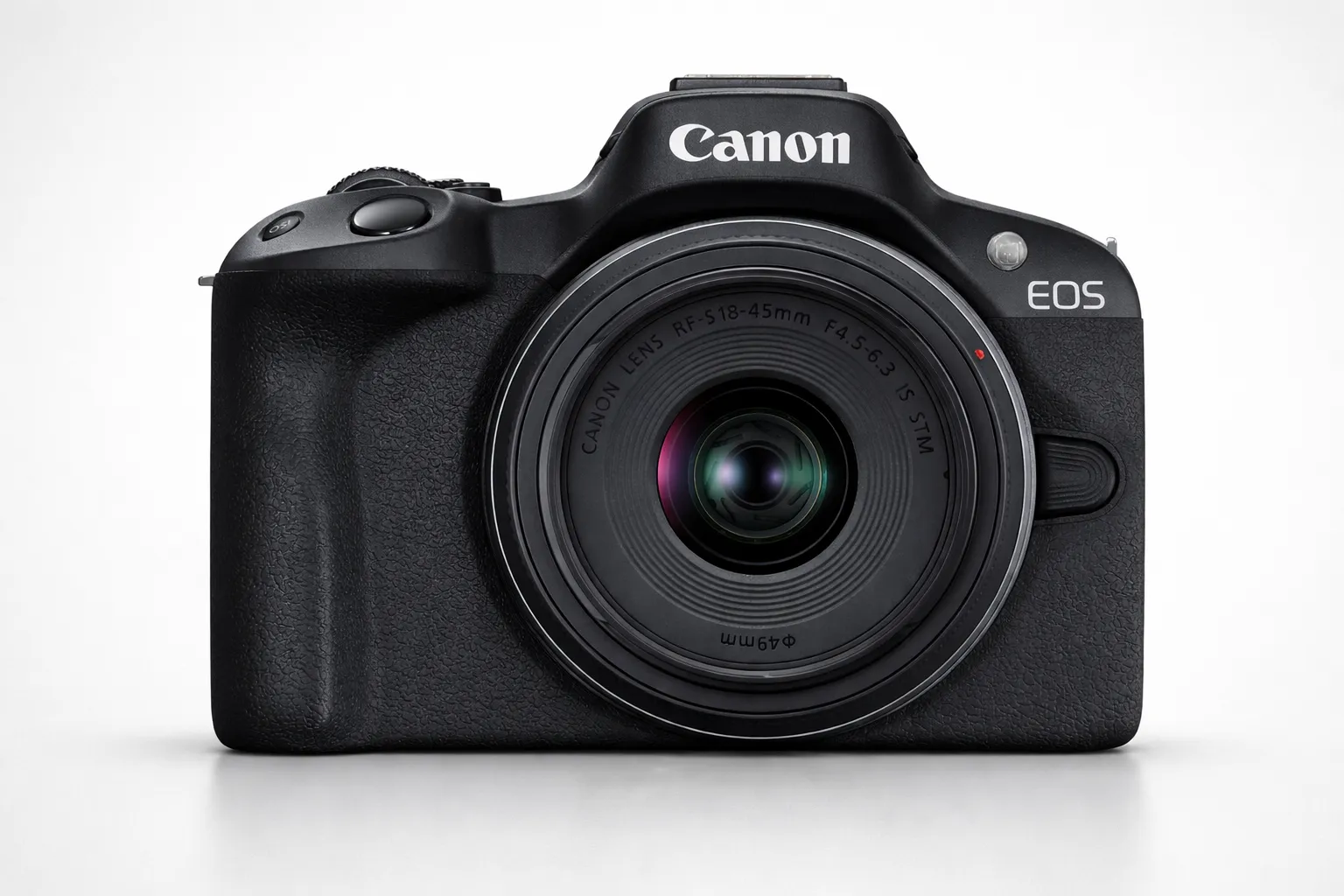
The R50 is a mirrorless body on Canon’s RF-S mount, sold here with the RF-S 18-45mm F4.5-6.3 IS STM zoom. That combination is the reason it leads this list: it is current, it is small, and the lens in the box covers everyday focal lengths without a second purchase.
RF-S is Canon’s designation for APS-C lenses on the RF mount. Full-frame RF lenses also mount on this body, so the system has somewhere to go later if you decide to keep investing in it.
- Current RF-S mount with a future
- Kit lens included, ready to shoot
- Smaller and lighter than a DSLR
- Costs more than the DSLR or the R100
- APS-C sensor, not full-frame
2. Canon EOS Rebel T7 — the cheapest way in
The T7 is a DSLR, not a mirrorless camera. It uses a mirror and an optical viewfinder, so you compose through the lens itself rather than on a screen. It is the lowest-priced camera here that still arrives with a lens, in this case an 18-55mm zoom, and it has built-in Wi-Fi.
The trade-off is the mount. The T7 takes EF and EF-S lenses, which is Canon’s older system. Those lenses are plentiful and often cheap secondhand, but they are not where Canon is putting its new development.
- Lowest price here with a lens included
- Optical viewfinder, no screen lag
- Enormous pool of affordable EF lenses
- Older DSLR design, larger and heavier
- EF-S mount is not Canon’s current direction
3. Canon EOS R100 — the cheapest route onto RF
The R100 is the entry point to Canon’s current mirrorless system. It takes the same RF-S 18-45mm kit lens as the R50 and mounts the same RF lenses, but sits below the R50 on price.
If the choice is between this and the T7, it comes down to which system you want to own. The T7 is cheaper; the R100 puts you on the mount Canon is actually building for.
- Cheapest body on the current RF mount
- Same 18-45mm kit lens as the R50
- Takes full-frame RF lenses too
- Positioned below the R50 in Canon’s range
- Still an APS-C sensor
4. Canon PowerShot V10 — the one that fits in a pocket
The V10 is not an interchangeable-lens camera. The lens is fixed, it is built as a compact vlogging camera, and it is the cheapest thing on this list. That makes it a different proposition entirely: you are buying portability, not a system.
Treat it as a second camera or a dedicated video device rather than a replacement for the R50. Whatever lens it ships with is the only lens it will ever have.
- Genuinely pocketable
- Lowest price in this guide
- Built for video rather than adapted to it
- Fixed lens — nothing can be changed
- Not a system you can grow into
5. Canon EOS R6 Mark II — the deliberate step up to full-frame
This is a full-frame mirrorless body, and the listing here is body only. There is no lens in the box. Budget for RF glass on top of a price that is already several times the R50’s, because a full-frame body with nothing on the front takes no pictures.
Full-frame is a real difference, not a marketing tier, but it is a difference that costs money across the whole system — bodies and lenses both. Buy it because you have a reason, not because it sits higher up the page.
- Full-frame sensor
- Current RF mount, no adapter needed
- Sits below the R5 on price
- No lens included — a significant extra cost
- Full-frame RF lenses are expensive
6. Canon EOS R5 — when the output has to pay for itself
The R5 is the most expensive camera here by a wide margin, and this listing pairs it with the RF 24-105mm F4 L IS USM — an L-series zoom, Canon’s professional line. Unlike the R6 Mark II above, this one does arrive with a lens.
This is equipment bought for work. If the camera is not earning, the money is better spent on the R50 and a second lens.
- Full-frame with an L-series zoom included
- Canon’s professional tier
- Ready to work out of the box
- By far the highest price here
- Overkill for anything but paid output
RF, RF-S and EF: the part that decides your next five years
Canon runs two lens systems at once, and the camera you choose locks you into one of them. EF and EF-S are the DSLR lenses — that is what the Rebel T7 takes. RF and RF-S are the mirrorless lenses, used by the R50, R100, R6 Mark II and R5. RF-S lenses are the APS-C ones; full-frame RF lenses fit the same bodies.
The practical consequence is simple. Buying into EF today means buying into the system Canon is winding down, which is exactly why those lenses are cheap secondhand. Buying into RF costs more now and leaves more room later. Neither answer is wrong, but it should be a decision rather than an accident.
How to Choose the Best Canon Camera for You
Check whether a lens is included before you compare prices. The R6 Mark II listing here is body-only and the others are not, which makes a straight price comparison misleading. Always read the configuration, not just the model name.
Decide between APS-C and full-frame on budget, not on prestige. Full-frame raises the price of every lens you will ever buy for that body, not just the body itself. An APS-C camera with two good lenses will usually serve you better than a full-frame body you cannot afford to put glass on.
Be honest about size. A DSLR is bigger than a mirrorless body, and an interchangeable-lens camera of any kind is far bigger than the PowerShot. The camera that stays at home because it is inconvenient takes no photographs at all.
The Second Lens Does More Than the Next Body Up
The kit zoom bundled with the R50, R100 and T7 exists to get you shooting on day one, not to be the lens you keep. For most people a second lens buys a bigger jump in picture quality than spending the same money moving one rung up the body range. Where that money should go depends entirely on the mount you just bought into.
On the RF-S bodies (R50, R100) the cheapest meaningful upgrade is a fast prime. The RF 50mm f/1.8 STM is a full-frame lens that mounts happily on these cameras and behaves like a short telephoto on them, which suits portraits and dim rooms. If reach matters more, the RF-S 55-210mm f/5-7.1 IS STM picks up where the kit zoom stops, and the RF-S 10-18mm f/4.5-6.3 IS STM goes the other way for interiors and landscapes. Those three cover almost everything a beginner runs into.
On the Rebel T7 the equivalents are the EF 50mm f/1.8 STM, the EF-S 55-250mm f/4-5.6 IS STM and the EF-S 10-18mm f/4.5-5.6 IS STM. This is where the older mount pays you back: those lenses have been in production long enough that the secondhand supply is deep and the prices are low.
On the full-frame bodies there is no cheap tier, so plan the lens before the body. If you already own EF glass, Canon’s EF-EOS R adapter carries it onto an RF body, which is usually a more sensible bridge than replacing a whole bag at once.
What You Still Need to Budget For
A camera listing is not the whole cost. None of these six are unusable out of the box, but there are three or four things you will buy inside the first month, and it is better to know that before you pick a model at the very top of your budget.
A memory card. Cameras are generally sold without one. For stills a mainstream card is fine; if 4K video is part of the plan, check the speed rating the model you chose actually asks for rather than buying the cheapest card on the shelf.
A second battery. This is the accessory people regret skipping. One battery is enough for a casual afternoon and not enough for a wedding, a hike or a full day of travel. Canon uses different batteries across these bodies, so buy the pack specified for your model instead of assuming an older camera’s spare carries over.
Something to carry it in. An interchangeable-lens camera with a second lens attached does not last long rattling loose in a backpack. The bag does not need to be expensive. It needs to exist.
A lens, eventually. Worth listing as a budget line rather than an upgrade, because it is the cost most often left out when two cameras get compared on price alone.
Reading Canon’s Model Names
Canon’s naming is one of the main reasons this category feels impenetrable, and four rules make the whole range legible.
A single-digit R means full-frame. R5, R6, R8 — and the smaller the number, the higher the model sits. A two- or three-digit R means APS-C, which covers the R50 and R100 here, and there a larger number means a lower-tier body. That reversal catches almost everyone out once.
“Mark II” is a generation, not a tier. The R6 Mark II is the second version of the R6, not a step above it in the range.
Rebel and the T-numbers are the DSLR line. A Rebel T7 is an EF-mount DSLR, a different system from anything with an R in the name, whatever the two cameras cost.
PowerShot means the lens does not come off. That is the entire distinction. A PowerShot can be an excellent camera; it simply cannot be grown with glass. Once those four rules are in place, a Canon listing tells you most of what matters before you read a single specification.
Refurbished and Used Are Fair Game Here
Cameras age far more slowly than phones. A body from the previous generation takes the same lenses and produces images indistinguishable in normal use from the current one, which makes the used market unusually sensible in this category rather than a compromise.
Canon runs its own refurbished store, and buying there instead of from a private seller gets you a warranty and a return path. If a model sits just above your budget at full price, that is the first place to look.
Buying privately is fine too, and the checks are short. On a DSLR like the T7, ask for the shutter count — it is the closest thing to mileage. On any body, photograph a bright, even surface at a small aperture to reveal sensor dust, confirm the battery still holds a day’s charge, and test every port and the card slot before money changes hands.
The Two Mistakes That Cost the Most
Spending the whole budget on the body. The most expensive error in this category is putting every available pound or dollar into the camera and leaving nothing for a lens, a card and a battery. A cheaper body with a second lens beats a dearer body stuck on its kit zoom nearly every time.
Comparing a body-only listing against a kit. This is the one that actually loses money, and it is easy to do accidentally. Two listings for the same camera can differ by the whole price of a lens, so the lower number on the page is not always the lower cost of getting a usable camera. Read what is in the box, work out what you would have to add to each option to reach the same setup, and only then compare the totals.
Treating the mount as a detail. The body is a five-year decision at most. The lenses bought for it tend to outlast it, and they only ever move to another body on the same mount. Choose the system first and the camera second, and the rest of the decision gets much easier.
Common Questions
Is a DSLR like the Rebel T7 still worth buying?
It can be, if the budget is fixed. It is the cheapest camera here that includes a lens, and EF lenses are widely available secondhand. The caveat is that you are buying into Canon’s older mount rather than its current one.
What is the difference between the R50 and the R100?
Both are APS-C mirrorless bodies on the RF mount and both ship with the same RF-S 18-45mm kit lens. The R100 sits below the R50 in Canon’s range and costs less. If the extra is affordable, the R50 is the more capable of the two.
Do I need full-frame?
Most people do not. Full-frame raises the cost of the body and every lens you buy for it. It is worth it when the output is paying for itself or when you have a specific requirement it solves.
Can I use RF-S and RF lenses on the same camera?
Yes — full-frame RF lenses mount on the APS-C RF bodies here. It is the reverse direction, putting RF-S lenses on a full-frame body, where the restrictions apply.
Which One to Buy
Buy the EOS R50 unless you have a specific reason not to. It is on the mount Canon is building for, it comes with a usable lens, and it does not commit you to full-frame prices. Go cheaper with the R100 or the T7 if the budget is the constraint, and go to full-frame only when you can name what it is solving. More options are in our camera buying guides, and the wider electronics guides cover the rest of the kit.